I've heard a lot of terms in my time to describe the US government: bloated, constricting, fat, amoral, etc.
But I've never heard constipated, until now that is...
When will Posner shut up? You'd think such a free market enthusiast would feel just a tad bit chastened after the financial meltdown. But no, he's still yabbering on like a senile old man on the porch of a house in Maine who smokes from a pipe and says ayuh a lot.

Over at Fusil of Yarn, samuelcanread takes on Krugman for tacitly approving of the inflation of a housing bubble back in 2002.
In the comments, samuelcanread adds:“Alan Greenspan needs to create a housing bubble to replace the Nasdaq bubble.”
True, he was quoting. But he was quoting somewhat approvingly.
I read it as Krugman saying we can’t let the economy deflate — that would suck so massively that it’s worth considering doing anything to get consumer spending going. Escape the liquidity trap!I don't see that in the article. It seems like Krugman's setting up a trade-off between the economy going back into recession and inflating another bubble. He implies that a housing bubble would be good for Bush and Greenspan, but I don't get a sense of how desirable this would be for the US economy. There's no mention of liquidity traps, deflation, or Japan in this article so I'm not sure where samuelcanread is getting that from.
Maybe the problem here is that we're employing an overly structuralist approach to the text. Perhaps we need to employ a more post-structuralist approach, where the text in fact has a plurality of meanings and reverse meanings that are created by the reader. Since Krugman wrote the text, he is ultimately responsible for these meanings. Get out the pitchforks!
P.S. Did I just write that? Maybe I am going insane, or even worse... becoming Deirdre McCloskey. Read more!
According to the New York Times, at least, a couple of distressed debt funds held up the negotiations over Chrysler, forcing it into bankruptcy. While I have absolutely no problem with distressed debt funds (I think they perform and invaluable service), I'm having trouble figuring out what the hell these guys are thinking. You don't play hardball on negotiations against the government when it is protecting blue collar jobs and at a time when wall street is reviled.
Is this part of the same phenomenon of banker indignation blogged about on Samuelcanread? Regardless, I hope that these guys are pilloried, not so much because they deserve it (although they do for being so stupidly arrogant: this is not an ordinary bankruptcy, the normal rules do not apply. You guys do realize you're going to start getting death threats?), but because we desperately need a scapegoat. We may very well need more tarp funds, if not a few nationalizations. I imagine this would be much easier to get if the American people saw a few more heads roll.
And Frank Rich thought he'd only be writing about Arlen Specter this week...
Oh joyful day. Brad Delong has returned to the Daily Gimpei. Witness this comment to my latest post. It is surely the finest example of the synthesis of the Sinnestrieb ("the sensuous drive") and Formtrieb ("the formal drive") into the Spieltrieb ("the play drive") since Schiller himself! It is short and yet it contains worlds:
I *do* have a day job...In honor of this most auspicious event, I do hereby declare April the 24th Brad Delong day, and will heretofore add him to my blogroll.
P.S. Brad may be off the hook, but there's still the little matter of Malaysia. Despite my entreaties, I haven't gotten a single hit! Watch out Malaysia, I'm posting photoshoped naked pictures of you unless I see some results. Read more!
Things are really heating up in the comment section to my post on Brad Delong's blog. A little context, Robin is taking issue with Brad Delong's critique of the media's reportage of a book by Amity Shlaes that questions the success of the New Deal. Brad thinks the book is deeply flawed and that its flaws aren't being properly emphasized by the media. Robin's response follows.
If a book says the earth is not round and congressmen and congresswomen are quoting it, then I do want to know what the hell they're thinking, or not thinking. Like Bush, I don't want to hear their whole argument or reality's forceful rebuttal. I just want to get a sense of this phenomenon on its own terms -- which de long is unwilling, but not ill-equipped, to do. I also want to know the arguments for the world ending in 2012 -- I don't need Brad DeLong to tell me it's not going to end on that date. And I don't really need a piece in the article saying "Experts say the world isn't going to end."Read more!
I think, Brad -- whether you be real or fake -- that you over-estimate the imprimatur those articles give Shlaes's opinion and under-estimate how interesting people like Shlaes and their arguments are, whether or not they're right. And i also think you over-estimate how effective your rebuttals are.
For instance, your attack on Updike got all the right points about where Updike was wrong about Shlaes being factually wrong. Good stuff! But you really couldn't think why anyone would want to know Updike's take on this book, whether or not he knew anything about Aggregate Demand? I loved your dismantling of all his and her errors. But you didn't give any credit to Updike for being sarcastic about her book throughout his summaries -- the rebuttal doesn't come at the end, it comes in little stabs like "in a bold stroke of pyschologizing" "[FDR] was more charming, she has to admit, than Hoover" and the condemnation of her style and structure - which for Updike perhaps isn't all, but enough to expose her as a sham. The point is he didn't need to be an economist to see through her. His mockery of her is as effective as yours, if not more so, for being so wry and charming in its Updikean way. And you also condemn him for his little novelistic take on the 1930s at the end. Jesus! I found that part really interesting, but I guess only economists can discuss those 10 years of history now. god forbid the New York Times ever quote Steinbeck again. Or Dos Passos. I'd actually enjoy your reading of Steinbeck, even though you'd apparently be utterly deaf to his style (or lack of it).
http://delong.typepad.com/sdj/2007/06/poor-john-updik.html
I'm objecting to the tone more than anything else: you get angry in a way that your supporters will cheer and the people who disagree will look elsewhere and the people who don't care will wonder why you're shouting. And you also come across as something of a cultural commisar, which is mean and absurd to say, given how generous you are with your thoughts when in a good mood and given that you're blogging. But your attitude when you want to fight your corner is basically what made Pravda so boring and useless: no need to give any time to enemies of the state, the central committee already established months ago they were ideologically and factually unsound.
One of the responses to my post on Brad Delong's was from a visitor named... Brad!
Is that you Professor Delong? If so, sit back in my massage chair, relax and make yourself at home. See that art deco liquor cabinet to your right, go ahead and open it. Feel free to pour yourself a snifter; I recommend the grappa.
What, you're leaving already? Have some more grappa... You look tense, would you like a shoulder rub? If you're an impostor, I'll be really angry. Actually, I really need the traffic. Check out my post on slate!
Don't mind that Robin guy who criticized you in the comments section; he's just being defensive because he's a journalist.
Between you and me, journalists are all lazy rubes. They're constantly writing on a deadline, so they don't have the time to check anything they say. Hell, they're so pressed for time that they often let the PR directors of the companies they're supposed to be monitoring write their copy.
As for journalists not reporting accurately on Keynes, the great depression, etc., agreed, criticize away!
At the same time, are you really surprised that the reporting is bad? The subject matter is complicated to the point of incomprehensibility. It's like asking someone to explain Hegel. Nobody understands Hegel, not even... Hegel! Now imagine trying to condense your explanation into a 250 word article. What would you do in this situation? What would you do?!
I know what I'd do: panic and call the first person I could find who could say something about Hegel. I wouldn't be stupid enough to call two people because they'd probably disagree leaving me back at square one. Then I'd send the copy off to my editor as quickly as possible. If it's biased, so what, it's the editor's job to fix that. Besides, I have forty minutes to get something out on Merleau-Ponty. Aaaah.
Where did Brad Delong's blog title, grasping reality with both hands, come from. Am I alone in finding it extremely irritating? I hope its derived from some famous quote; otherwise it's a perfect example of a horrifically overwritten title, like A Heartbreaking Jerk of Staggering Penis, only worse since there's no irony.
P.S. I do enjoy the blog, I just hate clicking on that title everyday in google reader.
Kahneman has some spot on analysis of the use of models in economics. The basic idea seems to be that people want models even if they don't work, because the illusion of certainty they provide is preferable to the reality of a world that is random and uncontrollable.
Reminds me a bit of the recent article on witch hunting in which Johann Hari theorizes that witch-hunting in the Congo is a way for people whose lives have been surrounded by death to regain some control. The collective misfortune of the community becomes the responsibility of the witch, and the witch's killing acts as a communal catharsis.
This also seems to relate to survivor's guilt and the tendency for people who have lost loved ones to feel a responsibility for their death. I've always thought of both of these phenomena as a way of asserting control: better to blame yourself than to accept the fact that the universe is fundamentally chaotic and that awful things can happen at any time for no reason and you can't do a thing about it. But I digress, enjoy the excerpts of the Kahneman's interview below:
Prof. Daniel Kahneman has dozens, perhaps hundreds, of stories about people's irrational behavior when it comes to making economic decisions. ... But the story Kahneman recalls when asked about the economic models at the root of the current financial crisis is actually taken from history, not an experiment. It concerns a group of Swiss soldiers who set out on a long navigation exercise in the Alps. The weather was severe and they got lost. After several days, with their desperation mounting, one of the men suddenly realized he had a map of the region.Read more!They followed the map and managed to reach a town. When they returned to base and their commanding officer asked how they had made their way back, they replied, "We suddenly found a map." The officer looked at the map and said, "You found a map, all right, but it's not of the Alps, it's of the Pyrenees."
According to Kahneman, the moral of the story is that some of our economic models, perhaps those of the investment world, are worthless. But individual investors need security - maps of the Pyrenees - even if they are, in effect, worthless. ...
"In the last half year, the models simply didn't work. So the question arises: Why do people use models? I liken what is happening now to a system that forecasts the weather, and does so very well. People know when to take an umbrella when they leave the house, or when it will snow. Except what? The system can't predict hurricanes. Do we use the system anyway, or throw it out? It turns out they'll use it."
Okay, so they use it. But why don't they buy hurricane insurance?
"The question is, how much will the hurricane insurance cost? Since you can't predict these events, you would have to take out insurance against many things. If they had listened to all the warnings and tried to prevent these things, the economy would look a lot different than it does now. So an interesting question arises: After this crisis, will we arrive at something like that? It's hard for me to believe."The financial world's models are built on the assumption that investors are rational. You have shown that not only are they not rational, they even deviate from what is rational or statistical, in predictable, systematic ways. Can we say that whoever recognized and accepted these deviations could have seen this crisis coming?
"It was possible to foresee, and some people did. ... I have a colleague at Princeton who says there were exactly five people who foresaw this crisis, and this does not include ... Ben Bernanke. One of them is Prof. Robert Shiller, who also predicted the previous bubble. The problem is there were other economists who predicted this crisis, like Nouriel Roubini, but he also predicted some crises that never came to be."
He was one of those who predicted 10 crises out of three.
"Ten out of three is a pretty good record, relatively. But I conclude from the fact that only five people predicted the current crisis that it was impossible to predict it. In hindsight, it all seems obvious: Everyone seemed to be blind, only these five appeared to be smart. But there were a lot of smart people who looked at the situation and knew all the facts, and they did not predict the crisis." ...
The interesting psychological problem is why economists believe in their theory, but this is the problem with the theory, any theory. It leads to a certain blindness. It's difficult to see anything that deviates from it."
We only look for information that supports the theory and ignore the rest. "Correct..." ...
Let's end with your story of the Swiss soldiers and the map of the Pyrenees. I know why the map helped the soldiers: it gave them confidence. But why didn't they use a map of the Alps? Why don't we use the right economic models, ones that are relevant to extreme cases as well?
"Look, it's possible that there simply is no map of the Alps, that there is nothing that can predict hurricanes."
Things aren't looking so good for neoclassics these days, what with all their models and artificially constructed puzzles melting before their eyes:
Charles Goodhart, who was fortunate enough not to encounter complete markets macroeconomics and monetary economics during his impressionable, formative years, but only after he had acquired some intellectual immunity, once said of the Dynamic Stochastic General Equilibrium approach which for a while was the staple of central banks’ internal modelling: “It excludes everything I am interested in”. He was right. It excludes everything relevant to the pursuit of financial stability.Exactly! By the way, this wasn't written by some heterodox crank, but rather a founding member of the Monetary Policy Committee of the Bank of England.
P.S. I'm not sure if it's good or bad to be a macroeconomist right now. I suppose its bad since everything has been thrown up in the air, but that also leaves so many promising new avenues for research. Read more!
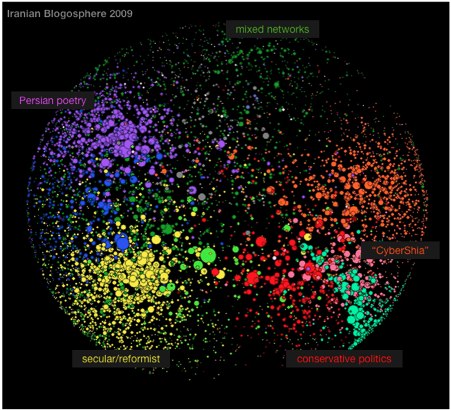
If I've learned anything from the many seminars I've attended over the years, its that pretty pictures are a huge asset. Take this map of the Iranian blogosphere. I don't know if it proves anything, but it sure looks cool. If I were a department head, it would make me more amenable to throwing some cash their way.
P.S. What's up with the massive interest in Persian poetry? Looks like all those friends of mine with Poetry MFAs have finally found their market. Now all they need to do is learn Persian...
I feel nothing but jealousy with respect to this research team who have gained access to 60 terabytes of Everquest 2 data! With so much data, they will surely be able to reach the mythical land of Asymptopia, where the laws of large numbers actually apply.
Read more!
David Brooks is a guilty pleasure of mine. Why guilty you say? Because I get the impression that he doesn't really have an opinion on anything and simply writes whatever seems hip. Take, for example, his wild love/hate swings on Obama, or his defense wayback when of big government conservatism.
Still, given that he's often taken as the metric of moderate conservatism, neoclassics may have reason to be worried:
The nation had essentially bet its future on economic models with primitive views of human behavior. The government had tried to change social psychology using the equivalent of leeches and bleeding. Rather than blame themselves, Americans directed their anger toward policy makers and experts who based estimates of human psychology on mathematical equations.I never know what Brooks believes because he often cages his statements in elaborate rhetorical devices. Here's one possible reading:
The government shouldn't intervene because it doesn't know what it's doing and will just make things worse. Economics isn't a science; it's just abstract mathematics.
If so, it's a pretty cunning about turn from someone who would have a few years ago turned to economists as a justification for the same end: don't intervene because markets are efficient (economists agree!).
It's certainly a better argument than the efficient markets hypothesis, but still seems flawed:
1) Not intervening is what got us here in the first place
2) The models may be flawed, but not all policy needs models. In fact, I'd argue the best policy is driven by common sense. The best thing Milton Friedman did was point out the obvious: there can't be a permanent trade-off between unemployment and inflation because people will eventually catch on and develop inflation expectations. No shit. I don't understand how anyone could have thought otherwise. Then again, looking at academia in general, there seems to be a huge incentive to argue for conclusions that defy logic; it's a lot more interesting than being told what you already know.
3) Economists do spend a lot of time thinking about the economy so they must know something. Just ignore their models, listen to their common sense arguments, and check up on their statistics. It won't be perfect but its better than nothing... I hope.
I'll leave you with this entertaining snip-it from an old Brooks piece that reminds me why I continue to read him:
When Democrats open their mouths, they try to say something interesting. If the true thing is obvious and boring, the liberal person will go off and say something original, even if it is completely idiotic. This is how deconstructionism got started.Read more!
I have my first irate comment. This is a good start, the sparing use of caps is a nice touch, as is the confusing grammar (what does "their" refer to in the second paragraph?). However, it would be nice if there was a bit more swearing and such. Could I suggest this as a template?
Anyway, onto the comment:
You're all over the place, Gimpei! You just repeated all the points i was making with my comment, and then claiming them as your own, at length.There's seems to be some confusion here. My argument was that assumptions about consumer behavior have been disproved, and yet the majority of macroeconomists have ignored this result and continue to use these assumptions as if nothing had happened. This suggests that these assumptions are insulated from empirical testing, i.e. they are not falsifiable.
The fact that your vaunted lab experiments FALSIFY their assumptions suggests they are FALSIFIABLE, no? So just say that their assumptions have been shown to be wrong. Otherwise you're like the Derridean who uses ersatz logical reasoning to proudly prove that there can be no such thing as logical reasoning.
For a science to be falsifiable in the Popperian sense, the scientists who are actually using these assumptions need to accept that they can be disproved, and need to agree on the manner in which they can be disproved. There doesn't seem to be a way to disprove neoclassical assumptions in economics, thus by Popper's criteria, economics is a pseudoscience. Is this clear?
This is my interpretation of Popper, not my own opinion. I'm a big fan of Daniel Hausman and highly recommend his book The Inexact and Separate Science of Economics. Read more!
Five responses to a single post, it's a Gimpei record! I have challenged you reader. Do you feel your mind expanding? It's because I'm blowing it! Hmm... that didn't come across right. Anyway, the debate seems to have progressed. Take the latest response:
We can predict the economy with much better precision than we can the weather: ie. I can tell you roughly what the economy in China will look in 6 months far more accurately than I could the weather -- even taking into account seasonal variations! So there goes meteorology.There are two fundamental problems with this comment:
1. I never said that predictive power is necessary for something to be a science.
2. Meteorology is a terrible example.
Let's start with problem number one. In the previous post I was giving reasons for why according to Popper economics is a pseudoscience.
In fact, I disagree with Popper on most points and think he's a terrible model for all sciences. Late Popper lets up a bit on the strict falsification criteria. However, he never managed to get around Kuhn's critique: if Popper's methodology had actually been followed, many of the our greatest scientific discoveries would never have been made. Popper's disciple, Lakatos, tried to deal with this problem; unsuccessfully in my opinion, but that's another story.
As for the content of the comment, predictive power is obviously not a prerequisite for a science. If it were, evolutionary theory, geology, etc wouldn't be sciences. Not even Popper would go that far. He just really disliked Freudianism and Marxism.
My point was that, from the point of view of Popper, for economics to be a science, it has to be possible to falsify any assumption. I argued in the previous post that there were certain privileged assumptions about consumer behavior that are immune to falsification: they aren't questioned when macro models fail and they aren't questioned when lab and field experiments suggest that people actually behave completely differently. There's actually a paper written by Popper where he tries analyze economics and its pretty entertaining to see him dance around the obvious conclusion that, by his criteria, it is a pseudoscience.
On to part 2: Meteorology is a stupid example.
You can predict the weather in six months with greater confidence than the state of the Chinese economy. In six months time, we have a pretty good idea that the temperature will be in a certain narrow band in China.
If only business cycles were as easy to predict as seasonal changes. China just posted a 20 million drop in employment! In six months, they could be sitting pretty or tanking. Are you clarevoyant or just exhibiting an overconfidence bias?
More fundamentally, Meteorologists aren't in the same position as macroeconomists since the science of meteorology on the micro-level is pretty sound. Last time I checked, we didn't have 30 years of experiments undermining the laws of thermodynamics!
Game, set, and match. Keep the comments comming; they grow more sophisticated by the minute. If you're lucky I may even tell you where Milton Friedman got it the most wrong (hint: it has nothing to do with free markets). Read more!
Romoney raised an interesting point in response to the previous post:
But aren't economic theories at least theoretically falsifiable? The problem is that they are so very hard to falsify.My answer is that by Popper's criteria, neoclassical economic theory is not falsifiable. I disagree with Popper fundamentally, and my memory is somewhat hazy, so let me apologize ahead of time for what is surely a crude bastardization of Popper's theory of falsifiability (at least early Popper).
There's an idea in the philosophy of science that comes out of logic called the Duhem-Quine problem. It basically says that certain scientific hypotheses cannot be disproved because in order to test them empirically you need to add extra auxiliary assumptions, and if the test fails you can simply reject the auxiliary assumptions rather than the original hypothesis.
Popper was well aware of this logical difficulty and argued that a discipline could only be considered a science insofar as it structured its tests in a manner that all hypotheses, not only auxiliary assumptions, can be falsified.
A cursory glance at economics reveals that there are certain sacred cows, termed the "hard core", that cannot be disproved. Take general equilibrium (DSGE) models, which forms the basis for a large amount of macro work. In DSGE models, a set of "hard core" assumptions in consumer theory allow hundreds of millions of people to be aggregated into a single "representative consumer."
These assumptions are extremely restrictive. Since the late seventies, behavioral economists have found in the lab, in the field, and with people from all walks of life that these assumptions are consistently violated. People simply do not behave in the manner assumed by neoclassical theory.
There are a plethora of responses by neoclassical economists: these tests have been performed in a lab so they don't apply in the real world; they may have been applied in the real world, but only to a few hundred people etc. These responses are normally followed by the claim that, through the magic of aggregation, inconsistencies on the individual level are miraculously smoothed out.
This argument might make sense if DSGE models actually worked, but they don't. Neoclassical economists like to say that their models are true because they "fit" a set of data that has been fed into them. However, this criteria of "fitness" hardly constitutes a test of their verity. This is because the coefficients in these models are simply adjusted (the technical term is "calibrated") until the best fit is reached. So these models fit by definition!
A better test of a model is whether, once calibrated for one set of data, it works as well with a different set of data: if we feed a new set of data (for which we already know the outcomes) into the model, to what degree do the predictions of the model match the actual outcomes. Unsurprisingly most models fail miserably at this point.
The true test, of course, is whether a model can predict outcomes in the real world. Unfortunately, as we have seen over the past year, they've seriously dropped to ball on this one.
Thus not only have neo-classical macroeconomists known for the past twenty-five years that their assumptions are wrong on the micro level, but their models don't work at the macro level either. Rather than questions these assumptions, because it would involve completely refashioning macroeconomics, they have, as predicted by Quine, simply rejected the auxiliary hypotheses particular to each distinct model. At this point there isn't any evidence left that could get them to change their minds; the "hard core" assumptions of macro are unfalsifiable.
If you've managed to make it this far in my post, kudos to you. I'd like to reiterate that I disagree fundamentally with Popper, but I do think that neoclassical macro is in a precarious state. The only thing that has kept it alive for so long is the absence of a competing research program. There's something called agent based modeling that could be promising, but it has been marginalized up until now by the neoclassics who control all the major journals. Given the myriad shortcomings of neoclassical macro, it seems worthwhile to at least give these guys a shot. If some major breakthrough were to come out of agent based modeling, it could reinvent macroeconomics on a far stronger microfoundation. Read more!
I've been meaning to read more econ blogs, because they are so insightful, especially about other disciplines. Take this post on Marginal Revolution:
The author is Kristin Luker and the subtitle is Research in an Age of Info-Glut. I enjoyed this book very much and I thought it was one of the best books on the philosophy of the social sciences I have read, ever. In part it is good because it ignores philosophy of science (and Continental philosophy gobbledy-gook) and focuses on the anthropology of how research is actually done. Here is the author's summary of her message
It's so true, philosophy of science is worthless unless of course it's Popper. Stephen Hawking likes Popper, and what is economics if not the physics of the social sciences? I need to read some Popper.
[Reads Popper]
Uh oh, seems Popper's philosophy implies that economics is a pseudo-science like marxism or psychoanalysis (according to Popper real science doesn't make unfalsifiable assumptions).
But wait! There's this person called Deirdre McCloskey, and she says that economics is a science. Except she's a postmodernist who doesn't believe that science reveals truth, tries to analyze economics as if it were literature, and has the uncanny ability to bore and annoy simultaneously.
Damn you philosophy of science! You've won this round, but I'll win the war by never reading you again and ignoring anything you have to say. After all, the proof is in the putting and look at how successful macroeconomics has been recently... except... doh! Read more!
Say it isn't so Dr. Olken. Please, say it isn't so. The root of all evil can't be television.
What about "The Wire?" I'm sure if Indonesian peasants were spending their time watching "The Wire" instead of normal TV, their social capital would increase hugely. Think of all the extra time spent around the watercooler puzzling over whether Omar's luck will ever run out...
Except their are no watercoolers in the jungles of Java. You've won this round Olken... But I'll be back.
P.S. I actually finished reading the article and it turns out that although television watching decreases social capital and attendance at village meetings, it has no effect on the quality of governance. Take home message: Don't bother trying to change things because evil always prevails; better to spend your time watching television so that you can escape from the cruel cruel world.
Take that Olken. Little did you know I had an ace up my sleeve going by the name of... Olken!
so much depends
upon
a legacy of
slavery
glazed with mistrust
measures
instrumented by distance
to coast
Subscribe to:
Posts (Atom)



 Posts
Posts

